Introduction to Safety#
4 min read
Brief#
Functional Safety is the reduction of unnecessary risk due to hazards caused by malfunctioning behavior of electronic safety systems. The International Electrotechnical Commission (IEC) created the standard IEC 61508 which defines methods on how to create systems which enable functional safety. In addition, the International Organization for Standardization (ISO) created an adaptation of this standard for automotive product development, ISO 26262. In this module, we will discuss how TI AM26x Microcontrollers enable functional safety applications, what resources are provided by TI for functional safety, and additional relevant standards.
As the automotive and industrial markets become more autonomous, they face an increasing need to meet stricter functional safety standards. These standards are designed to minimize equipment failures and physical injury that could result from two types of hardware faults, systematic faults and random hardware faults.
Please refer the device datasheet to read more.
Safety Integration Levels#
Functional safety involves a safety integrity level (SIL) or other similar quantitative metric. A SIL applies to a safety function from start to finish, and affirms that the system reverts to a safe state or performs even during incorrect operation or a loss of functionality (in fault-tolerant architectures). Both the design and process must follow functional safety standards such as IEC 61508 or ISO 26262, and pass independent functional safety audits in order to achieve the corresponding quantitative metrics that assess appropriate safety standards.
TI AM26x Microcontroller sensors are designed according to an extensive hardware and software development process and are supported by device certification from Technischer Überwachungsverein (TÜV) SÜD.
Industrial Portfolio SIL Ratings#
Device |
Hardware Capabilities |
Systematic Capability |
Third Party Assessment + Device Certification |
|---|---|---|---|
AM263x |
SIL-3 |
SIL-3 |
(TÜV) SÜD |
AM263Px |
SIL-3 Targeted |
SIL-3 Targeted |
(TÜV) SÜD (In Progress) |
Automotive Portfolio ASIL Ratings#
Device |
Random Hardware Capabilities |
Systematic Capability |
Third Party Assessment + Device Certification |
|---|---|---|---|
AM263x |
ASIL-D |
ASIL-D |
(TÜV) SÜD |
AM263x |
ASIL-D Targeted |
ASIL-D Targeted |
(TÜV) SÜD (In Progress) |
Safety Responsibility: Who does What?#
Texas Instruments, assessors, and system integrators/customers all play a role in safety.
Texas Instruments#
TI has developed Functional Safety rated hardware and software via development processes which are certified by a Functional Safety assessor. Additionally, TI provides documentation, certificates, and relevant support packages to customers.
Below is a list of resources provided with TI Functional Safety compliant microcontrollers, organized by where to find them.
Resource Name |
Resource Type |
Location |
|---|---|---|
TI Certificate for Functional Safety Hardware Development Process |
Document |
|
TI Certificate for Functional Safety Software Development Process |
Document |
|
Safety Diagnostics Library |
Software Package |
ti.com Product page (MCU_PLUS_SDK) |
Related Standards#
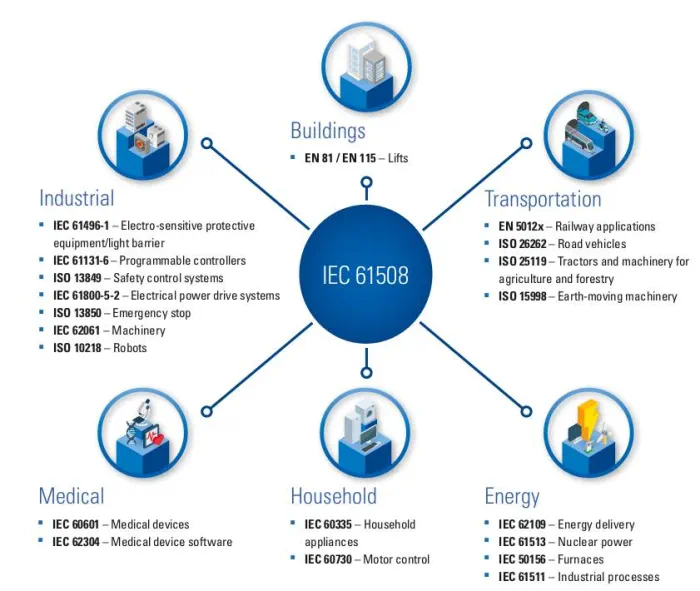
Various safety related standards have also been created for specific applications, with their scope varying from chip-level to system-level. Some have been around for decades and some have been published within the last year. It is important to know and understand what standards and regulations apply to the type of product you are looking to develop, and Figure 1 below shows some of the existing standards that can apply to safety systems which include a radar sensor.
References#
TÜV SÜD certificate for Automotive Radar Devices
TÜV SÜD certificate for Industrial Radar Devices
The Radar Functional Safety Enables application note shows an overview of some available resources
Application note on Streamlining Functional Safety Certification in Automotive and Industrial
The ti.com Functional Safety Home shows an overview on how TI handles functional safety